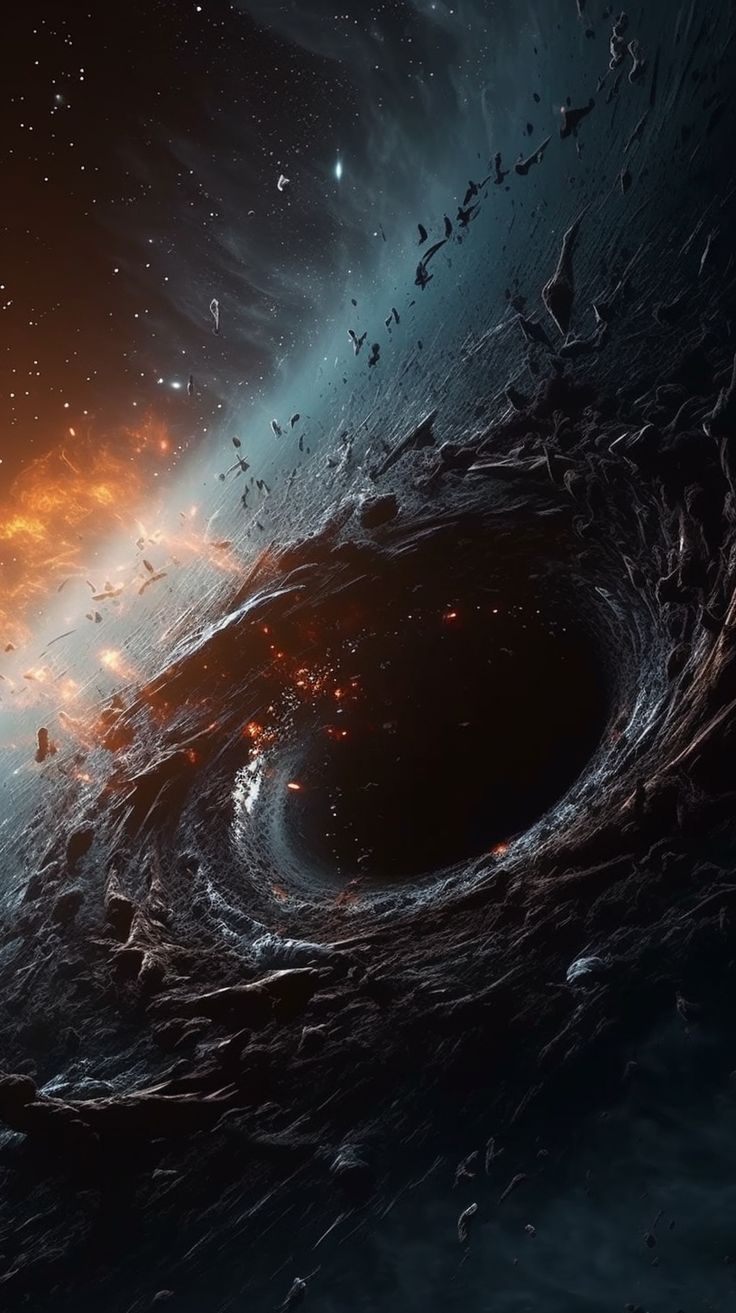
The Mysteries of Black Holes: Gateways to the Unknown
Since the dawn of astronomy, black holes have captured human imagination. These invisible giants, capable of swallowing light itself, challenge everything we know about physics, space, and time. But what exactly is a black hole, and could it really be a gateway to another universe?
What Is a Black Hole?
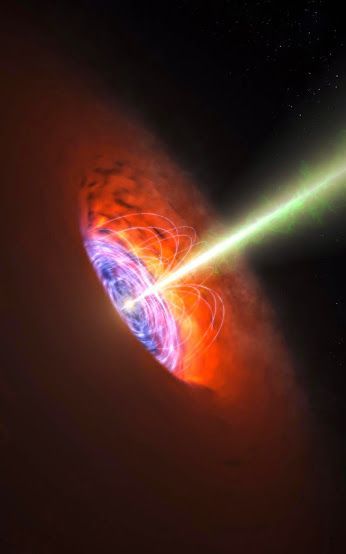
A black hole is formed when a massive star collapses under its own gravity after a supernova explosion. Its core becomes infinitely dense — a point known as the singularity — where gravity is so strong that even light cannot escape. Surrounding it lies the event horizon, the boundary beyond which nothing returns.
Types of Black Holes
Astronomers have identified several types:
- Stellar Black Holes — formed from dying stars.
- Supermassive Black Holes — millions or billions of times heavier than the Sun, found at galaxy centers.
- Intermediate Black Holes — rarer and mysterious, possibly formed from merging smaller ones.
- Primordial Black Holes — hypothetical remnants from the early universe.
Theories and Possibilities
Physicists like Stephen Hawking proposed that black holes might emit radiation — now called Hawking radiation — slowly evaporating over time. Some theories even suggest black holes could connect to wormholes, acting as bridges to other parts of the universe or parallel realities.

A Glimpse into the Future
With missions like the Event Horizon Telescope, humanity captured the first image of a black hole in 2019 — a milestone in science. The next decades may reveal more: how they evolve, how they shape galaxies, and perhaps even how they could unlock new dimensions of existence.
The Birth and Death of Stars: The Life Cycle of Cosmic Giants
Stars are the heartbeat of the universe — brilliant furnaces that illuminate galaxies and create the very elements of life. Yet, every star, no matter how powerful, follows a grand cosmic cycle: birth, life, and death.
Birth in the Nebula
Stars are born in massive clouds of dust and gas called nebulae. Over millions of years, gravity pulls hydrogen atoms together, increasing pressure and temperature until nuclear fusion ignites. A new star is born — shining brightly in the cosmic dark.
The Glorious Life of a Star
A star’s life depends on its mass. Smaller stars, like our Sun, burn steadily for billions of years, fusing hydrogen into helium. Larger stars live faster and die younger, consuming their fuel in a cosmic blaze of energy.
The Death of a Star
When a star runs out of fuel, its fate depends on its size:
- Small stars cool into white dwarfs.
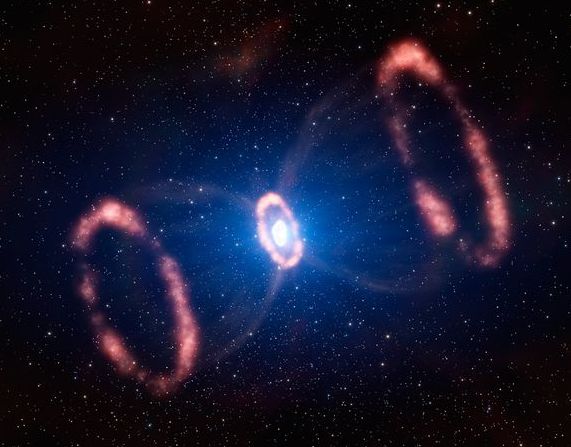
- Massive stars explode as supernovae, scattering elements across space.
- The largest may collapse into neutron stars or black holes, leaving behind a cosmic mystery.
The Universe’s Endless Cycle
The materials from dying stars enrich the universe, forming new nebulae — and the cycle begins again. Every atom in your body was once forged in a star’s fiery heart. In a sense, we are all made of stardust.
The universe is all of space and time and their contents, including all forms of matter and energy. The prevailing scientific explanation for its origin is the Big Bang theory, which describes its evolution from an extremely hot, dense state approximately 13.8 billion years ago.
Origin and expansion
- The Big Bang theory: This model states that the universe began from an infinitesimally small, hot, and dense point, and has been expanding and cooling ever since.
- Expansion evidence: The theory is supported by several key observations:
- Distant galaxies are moving away from our own, and the farther away they are, the faster they are receding, as described by Hubble’s Law.
- The existence of the cosmic microwave background (CMB), a faint echo of leftover heat from the Big Bang, fills the entire universe.
- The observed abundance of light elements like hydrogen and helium matches the predictions made by Big Bang nucleosynthesis, which occurred in the first few minutes after the event.
- Cosmic inflation: In the first tiny fraction of a second, the universe is thought to have undergone a period of intense, rapid expansion called inflation. This explains why the universe appears spatially “flat” and uniform on large scales.
- Accelerating expansion: About 5–6 billion years ago, the expansion of the universe began to accelerate, an effect that scientists attribute to a mysterious force called dark energy.
Composition of the universe
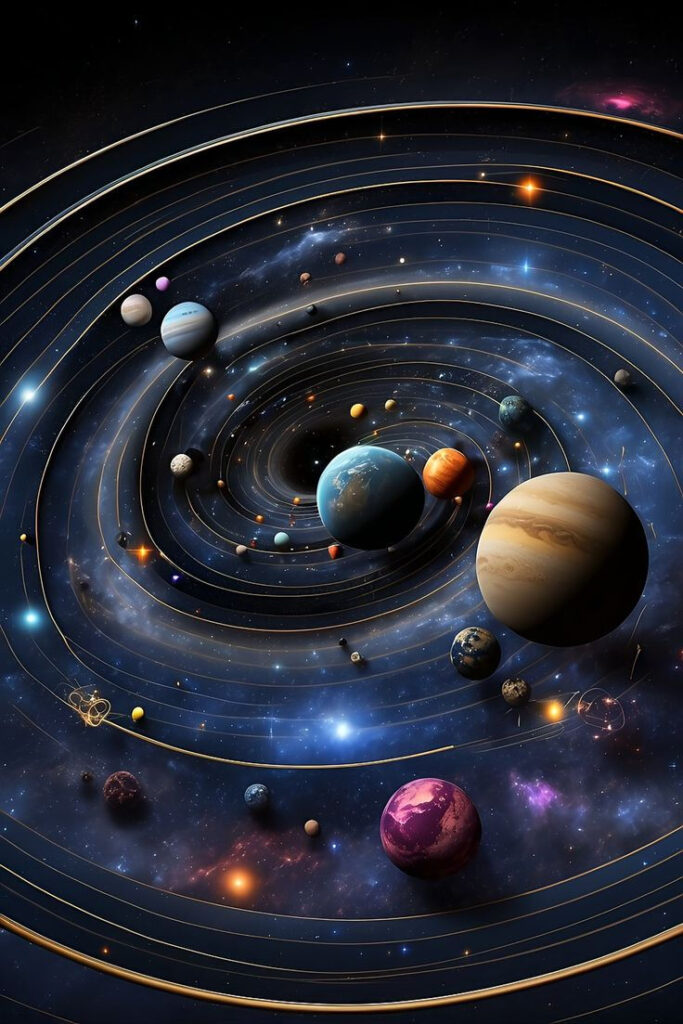
The universe’s total mass-energy is primarily composed of three components, most of which are invisible and not well understood:
- Dark energy (68.3%): An unknown form of energy that is causing the expansion of the universe to accelerate. It is thought to be a uniform force acting against gravity on cosmic scales.
- Dark matter (26.8%): A hypothetical type of matter that does not absorb, reflect, or emit light. Its existence is inferred from its gravitational effects on visible matter, such as the movement of galaxies.
- Ordinary (baryonic) matter (4.9%): This is all the matter we can see and interact with. It includes the atoms that make up stars, planets, and all life. Most of this ordinary matter is made of hydrogen and helium.
Scale and Structure
- Observable vs. total size: The entire universe may be infinite, but because of the finite speed of light and the universe’s age, we can only observe a certain portion of it. The observable universe is approximately 93 billion light-years in diameter.
- Large-scale structure: At the largest scales, matter is distributed in a vast, web-like “cosmic web” of immense galactic filaments and clusters. These surround giant voids of relative emptiness.
- Galaxies and stars: The observable universe contains an estimated 2 trillion galaxies and more than 10²⁴ stars. Our own Milky Way is just one of these galaxies.